Saturday, March 30, 2024

Backward Design Center for the Advancement of Teaching Excellence University of Illinois Chicago

backwards design

Using a process like backward design helps us get better at making these decisions. By making this approach part of our regular practice, we’ll be able to look back on a day, a week, or a year of teaching and say with a lot more certainty that when they were under our care, our students learned. Like I did, you probably also have some favorite lessons and activities. Some of these might turn out to be not just fun to teach, but also solid in terms of equipping students with knowledge and skills that will last.

"We are really evolving, just backwards": MSCHF Backward shoes design spark hilarious reactions ahead of release date - Sportskeeda

"We are really evolving, just backwards": MSCHF Backward shoes design spark hilarious reactions ahead of release date.

Posted: Sun, 26 Mar 2023 07:00:00 GMT [source]

The 9 best gifts for content creators in 2023

It is made up of six non-hierarchical ‘domains’ or ‘facets’ that they identify as indicators of understanding. Assessment refers to the wide variety of methods or tools that educators use to evaluate, measure, and document the academic readiness, learning progress, skill acquisition, or educational needs of students. Bloom’s Taxonomy is a great tool in helping to identify action verbs appropriate for measurement. In the first stage of backward design, instructors identify what students should know, understand, and be able to do by the end of the course, lesson or module. Learning outcomes describe what students know or can do, not what the instructor does. Remember that “students” is the subject of the generic learning outcome stem shown at the beginning of this section.

Stage 1: Identify Desired Results

Education authorities establish a curriculum in a top-down manner that may not fully address the circumstances in a classroom. With this “after” version, every lesson is designed to prepare students to give excellent presentations at the end. The whole time, they are using the lunar cycle vocabulary, correcting each other’s misconceptions, and just like scientists, thinking about how to explain concepts to other people. If we assume that a large portion of a student’s grade is based on the test, then students are not being measured on their achievement of that standard. The standard does not require students to memorize the phases of the moon.

Stage One – Identify Desired Results:

They will never sit for a test and not know what the test is talking about or what he wants them to do. Unfortunately, this results in tests or assessments that don’t always reflect what the students did or learned. We’ve all experienced an unfortunate class or two where the test didn’t seem to reflect anything we had learned in lessons or course materials up until that point. I was first introduced to this concept in my sixth year of teaching, and the genius of it completely blew me away. I used it when planning my next unit and experienced the biggest spike in student success I’d ever seen. On top of that, I was actually excited about teaching the lessons I had planned.

The teacher has created an authentic task in which students will design a 3-day meal plan for a camp that uses food pyramid guidelines. One criticism of this approach is that is appears to promote “teaching to the test”. Yet despite the negative connotation that comes along with that phrase, arguable teaching to the test is exactly what the role of the instructor should be. But if a known final test or assessment is required, then backward design can be a useful way to prepare learners to perform well on the final assessment.

FAQs About Backwards Lesson Planning

These random activities are taking up precious time that could be spent on much more valuable stuff. I mean, even though I loved the book, my students’ response to it was mostly lukewarm. Maybe it was the connections I was able to make to the stuff students dealt with on a day-to-day basis.

County Planning Department pushes 'gas backwards' idea for Byrne Dairy's Route 63 proposal - The Batavian

County Planning Department pushes 'gas backwards' idea for Byrne Dairy's Route 63 proposal.

Posted: Fri, 15 Mar 2024 07:00:00 GMT [source]

The benefits & advantages of online learning

The concept of Backward Design was invented by two education experts named Grant Wiggins and Jay McTighe in the late 1990s. Their goal was to make learning more focused and useful, not just for kids in school but also for adults in professional settings. The big ideas and important understandings are referred to as enduring understandings because these are the ideas that instructors want students to remember sometime after they’ve completed the course. Using anticipated learning outcomes for backward design of a molecular cell biology Course‐based Undergraduate Research Experience. Wiggins and McTighe propose a framework called Six Facets of Understanding as a guide for building effective assessments.
backwards design

Or you might keep them for other reasons—not every minute of class time has to be spent on standards-based instruction. Some activities have value because they help us get to know each other better, they help students develop social-emotional skills, or they simply offer a bit of fun. But if a lesson doesn’t do any of these things, if it’s disguised as learning but is doing little more than keeping students busy, it’s time for it to go. The traditional approach to education planning, sometimes called "Forward Design," usually starts with content and activities. Teachers first decide what to teach (content), then how to teach it (methods and activities), and finally, how to evaluate learning (assessment). At this stage it is important to consider a wide range of assessment methods in order to ensure that students are being assess over the goals the instructor wants students to attain.

Dick and Carey model (also known as the systems approach model)

Academic standards usually provide the best direction for educational goals. For example, according to the Common Core Standards for Mathematical Practice, students should be able to understand the concept of ratios by the end of sixth grade. It is the teacher’s job to determine, via backward lesson design, how their students will reach the necessary level of proficiency. If it turns out that those favorite lessons don’t really align with any standards, you might be able to revise them so they do.

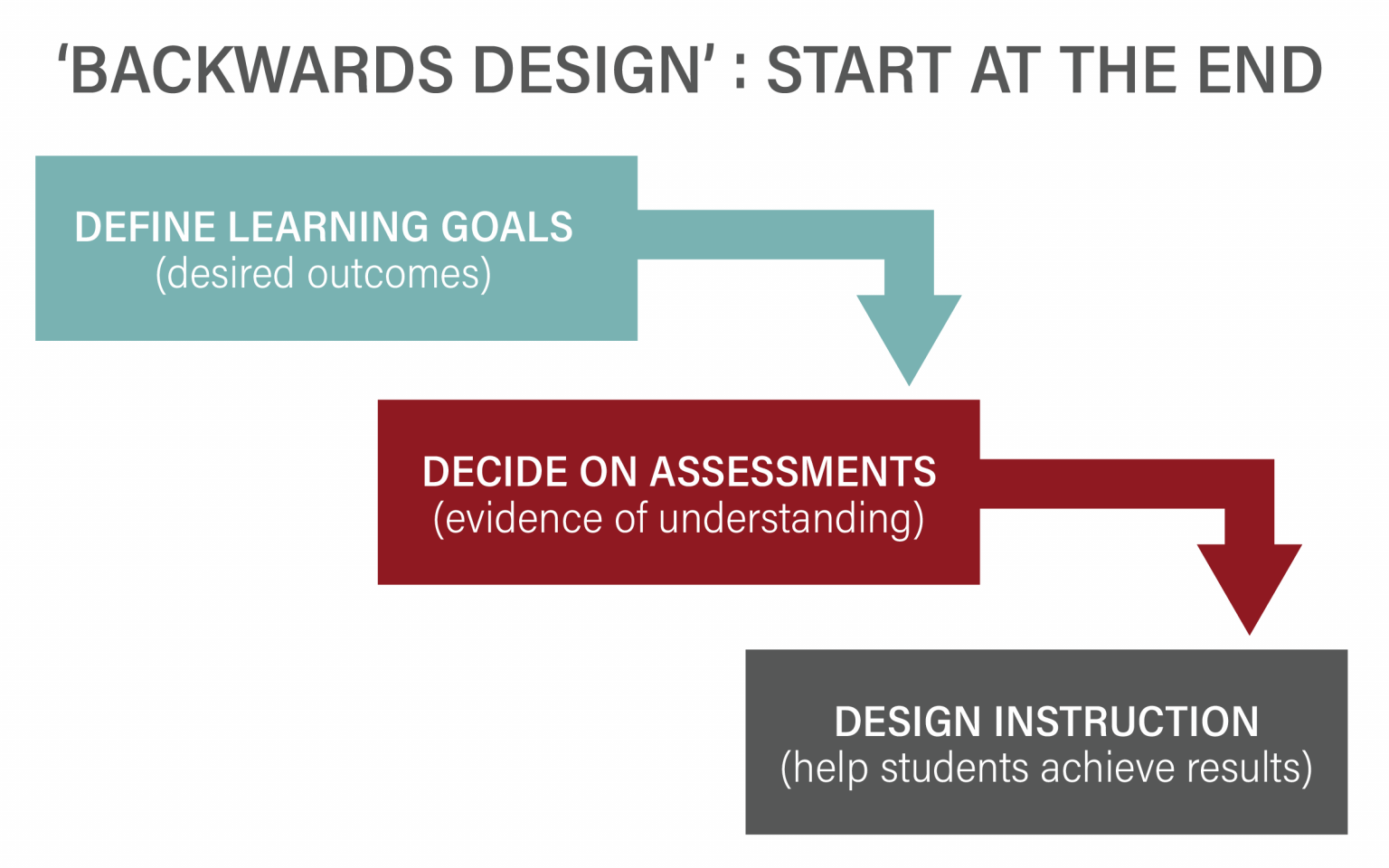
For this reason, backward design is considered a much more intentional approach to course design than traditional methods of design. Traditionally, instructors have applied a forward or content-centered approach to designing lessons, modules, or courses. This approach typically ends with crafting learning objectives to connect the content learned to the assessments. Backward design in education is a lesson planning strategy that starts with the final assessment, then asks teachers to build their lessons toward that goal. This differs from transitional lesson design, in which teachers identify content they need to cover, build relevant lessons, then create the final assessment. Backward lesson design encourages teachers to be more intentional about their lesson plans and ensures that they make the best use of class time.

In traditional curriculum planning, a list of content that will be taught is created and/or selected.[4] In backward design, the educator starts with goals, creates or plans out assessments and finally makes lesson plans. Supporters of backward design liken the process to using a "road map".[5] In this case, the destination is chosen first and then the road map is used to plan the trip to the desired destination. In contrast, in traditional curriculum planning there is no formal destination identified before the journey begins.

In particular, beware of words like “understand” or “know.” Exactly what it means to “understand” or “know” something is open to interpretation. An undergraduate’s level of “understanding” of a topic and that of the instructor will vary wildly, and it will be difficult for students to know which level of understanding they should be aiming for. When developing ILOs, ask yourself how you will know that a student “understands” the material – what will they need to do, or say to demonstrate their understanding? Your answer to this question should provide you with more specific (and measurable ILOs.

Section 1: Assessment Methods & Backwards Design Fit for Online Learning

backwards design

Using the Backwards Design approach will help you align your assessment, curriculum, and instruction. Summative Assessment involves graded activities that occur at the end of learning. Research over the past several decades has shown that students learn more and retain their learning longer if they acquire it in an active rather than a passive manner. Examples of summative assessments include exams, portfolios, presentations, written work. “Aligning teaching for constructive learning.” Higher Education Academy Discussion Paper.

backwards design

Step 3: Design Content for Instruction

Abackward design lesson plan can be an excellent way to improve your student outcomes and learning processes. If you’re an online course creator, an online tutor, or a teacher of any other type, you probably develop your lessons in the same way. You study standards, learning objectives, or profit margins, then create your lessons and learning materials based on those goals.

Evolution Over Time

The key question is whether a one-size-fits-all approach can adequately cater to a classroom that is increasingly diverse in terms of learning styles, physical abilities, and cultural backgrounds. Scholars in the field of special education, such as Thomas Hehir, question whether the Backward Design framework is flexible enough to accommodate learners with diverse needs. Issues around accessibility, differentiated instruction, and cultural responsiveness come to the fore. The rigidity of the Backward Design framework has also been critiqued by educators like Sir Ken Robinson, who champion the benefits of creativity and freedom in educational settings. Educational scholars like Alfie Kohn have raised concerns that an approach like Backward Design, which starts with outcomes and assessments, might place too much emphasis on testing and grading.

Time-Consuming Planning Phase

This method is rooted in the constructivist theories of educators like Jean Piaget. Like Backward Design, Inquiry-Based Learning encourages higher-order thinking skills. However, it differs in that the learning process is far less structured, often initiated by a question or problem posed by the students themselves rather than pre-defined learning objectives. One of the most celebrated aspects of Backward Design is its focus on clear learning objectives.

These assumptions may not accommodate the needs or potential of individual students. Okay, so we’ve looked very closely at one small unit for a middle school science class. As educational paradigms continue to evolve, frameworks like Backward Design will likely undergo revisions and adaptations. Current trends in educational technology, personalized learning, and inclusive education all offer exciting avenues for integrating and evolving the principles of Backward Design.

Red Dead Redemption 2's Open World Is Amazing Because It's Designed Backwards - TrueAchievements

Red Dead Redemption 2's Open World Is Amazing Because It's Designed Backwards.

Posted: Sat, 09 Mar 2019 08:00:00 GMT [source]

I had decent relationships with my students and I believe most of them had good experiences in my classroom, but real, durable learning? By following these practical tips, educators can take meaningful steps towards successfully implementing Backward Design. The transition may come with its challenges, but the potential benefits for both teachers and students are substantial. Teachers like Carol Ann Tomlinson, known for her work on differentiated instruction, have noted that when students understand what they're working towards, they are often more engaged and motivated. Backward Design’s focus on clear objectives and transparent assessments lets students know what's expected of them, which can enhance their motivation to succeed. Plus, because Backward Design focuses on real-world skills and applications, students can easily see the value in what they're learning.

Once you have worked through the three steps of backward design, you should make sure that all elements (objectives, assessments, learning activities, and instructional materials) align with each other. This last example provides intended learning outcomes for a subject focused more on soft skills, where measuring student ability objectively is significantly more nuanced and difficult. However, these ILOs still communicate crucial information to students about what good communication looks like to the instructor and help them better understand what will be expected of them in the course. Looking ahead to step two of backward design, you will need to identify evidence that an intended learning outcome has been obtained. If a learning outcome is not measurable, then we will not be able to know whether or not our course successfully achieved its goals. Contrary to a popular assumption, this does not mean that the leaning goal has to be quantitatively measured by some objective instrument (like a multiple-choice test).

Prioritize Student Understanding

Let’s take a look at an example to illustrate the difference between a unit planned the traditional, topic-driven way, and the same unit planned with backward design. Some chapters we did in class (I would read to them, then they would read silently), and others at home. Some students became as absorbed in the novel as I’d hoped they would; others, not so much. Predictably, some fell behind in the book like they did with all assigned reading.

Teaching to the Test vs. Teaching the Test

In the simplest terms, Backward Design is like planning a treasure hunt. Instead of starting with the first clue, you begin by planting the treasure—your final learning goal. Because understanding how Backward Design works can make anyone a better learner and even a better teacher, whether you're helping your kid with homework or leading a team at work. Plus, it's a learning tool that schools and companies are using more and more, so it's good to know what it's all about. You walk away really getting it, able to use what you learned in real life. Well, there's a good chance the person teaching you used Backward Design to plan that awesome learning experience.

A well-designed rubric can help you align your assessments to your intended learning outcomes. Your learning outcomes should be achievable for the students in your class and achievable in the time allotted to your subject. Crafting realistic learning outcomes requires some understanding of students’ prior knowledge and skills in your subject. Instructional strategies are the teaching methods by which you present new information to your students.

When teachers are designing lessons, units, or courses, they often focus on the activities and instruction rather than the outputs of the instruction. Therefore, it can be stated that teachers often focus more on teaching rather than learning. This perspective can lead to the misconception that learning is the activity when, in fact, learning is derived from a careful consideration of the meaning of the activity.

And in the face of a new teaching environment (e.g., online), it becomes clear just how crucial it is that we create authentic, pedagogically sound assessments. Now it is time to plan the lessons, determine reading assignments, method of instruction, and other classroom activities to support student learning. With students’ needs in mind, instructors can choose the most appropriate methods to help their students achieve the learning objectives. The primary starting point for backward design is to become familiar with the standards/outcomes for the grade level and curriculum being taught. The second part of curriculum planning with backward design is finding appropriate assessments.

The following examples are simply suggestions for what creating backward design lesson plans might look like. When creating your own lesson plans, please refer to your state’s or school’s specific academic standards. Furthermore, when a teacher designs a lesson without a plan for the final assessment, they may be tempted to add activities or units to the lesson just for the sake of filling class time.

Alignment is the degree to which learning objectives, assessments, learning activities, and instructional materials work together to achieve the desired course goals. The backward design approach to curriculum planning enables educators to provide goal-centered instruction. With learning objectives centered, students can appreciate the relevance of the instructional content. The backward design approach for curriculum development applies to individual lesson plans through the backward mapping approach.

While these challenges and criticisms provide a more nuanced view of Backward Design, they don’t necessarily invalidate its effectiveness. Many educators find ways to adapt the approach to suit different learning environments and needs. By acknowledging these theories and the scholars who contributed to them, we not only appreciate the intellectual roots of Backward Design but also understand its strong academic underpinnings.

Formative assessment expert Paul Black advocates for continuous improvement through the feedback loop, which involves tweaking the lesson plans based on student performance and other data. Educators like Lorin Anderson, who revised Bloom's Taxonomy, appreciate that Backward Design encourages higher-order thinking skills. Because educators start with the end in mind, they can plan activities that go beyond rote memorization, facilitating skills like analysis, evaluation, and creation. This helps students become not just passive receivers of information, but active constructors of knowledge. Renowned educator Grant Wiggins, one of the creators of Backward Design, emphasized the value of well-defined learning goals in providing direction to both teaching and learning. When discussing the theoretical foundations of Backward Design, it's impossible to ignore Constructivism.

Trichotillomania: Symptoms, Causes, Treatment, and More

Table Of Content The Best Hair Salons in Every Major City, According to Editors Understanding Trichotillomania: The Urge to Pull Out Your Ha...